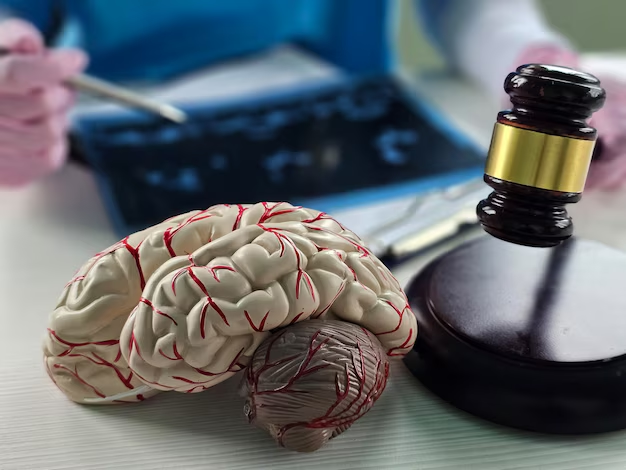
A question that has always fascinated me is what happens when someone with a neurological disorder commits a crime. Is it really their fault? Was it really ‘them’ committing the crime? How should they be punished – if at all?
With the recent rise in gun violence and its ties to mental health struggles, this question becomes increasingly pertinent. I just finished reading the incredibly detailed, well-written memoir The Tale of the Dueling Neurosurgeons by Sam Kean about the history of neurological disorders. This book kept me engrossed with its no-nonsense narration and jarring (and sometimes pathetically humorous) stories of all the strangest ways our brains can malfunction. One of the many themes that stuck out to me was responsibility for actions that we execute but our brains dictate. Kean does a phenomenal job in illuminating the extent to which we are governed by the raw physiology of our brains. Where does person begin and squishy grey matter end?
I used to take a harsher stance on individuals with a neurological disorder who committed crimes or misdemeanors. In fact, I was so enthralled by this subject that I wrote my AP Seminar Individual Written Argument on the legal responsibilities of those diagnosed with dissociative identity disorder (linked below if you’re curious!). And after conducting a thorough literature review, I concluded that their diagnoses should not be a primary consideration in criminal trials; their crime’s impact on society and safety should carry more weight.
But Kean’s commentary complicated that clean conclusion. Reading an objective account of how neurological disorders develop anatomically forced me to take a step back. If a portion of the brain is annihilated by a sudden, tragic event causing a once pleasant person to develop aberrant behaviors in late life, it feels morally wrong to punish them, especially if every other aspect of their identity remains the same. Kean’s stories make it hard to draw a clean line between “the person” and “the brain.” For example, he recounts about patients with corpus callosum disruptions whose non-dominant hand acts on its own, usually in mischievous ways, even as their personality, memory, values, and intellect remain untouched. He words this dilemma beautifully when he writes:
“Our entire legal system is built on the premise that people who understand right and wrong are accountable for their actions. But in the light of neuroscience, jurists have struggled with in-between cases —cases where someone understands right and wrong, and even understands the need to choose right over wrong, yet lacks the power to” (178).
I still believe that the outcomes of actions should matter, especially in criminal justice. But perhaps these stories can inform our present-day issues in a way that balances accountability with preventative action. Maybe the future of the justice system will involve neuroscientists and biologists. After all, what a refreshing reminder this book was of how complex yet fragile our brains are.
My AP Seminar Individual Written Argument on the legal responsibilities for those with dissociative identity disorder
Up Next!
Next, I will read When Breath Becomes Air, a book recommended to me by many. I’ve heard that it is a painful, heart wrenching narrative that highlights the knowledge and experience gap between physicians, researchers, and cancer patients.
 Telos and Tangents
Leave a comment