Summary: While volunteering at a senior living center, I encountered Inna, a former classical pianist from Ukraine whose life stories deeply resonated with me as a child of immigrants. Our conversations and a promise to perform Beethoven’s Pathetique Sonata rekindled my passion for music and highlighted the importance of connecting with others across generations.
***
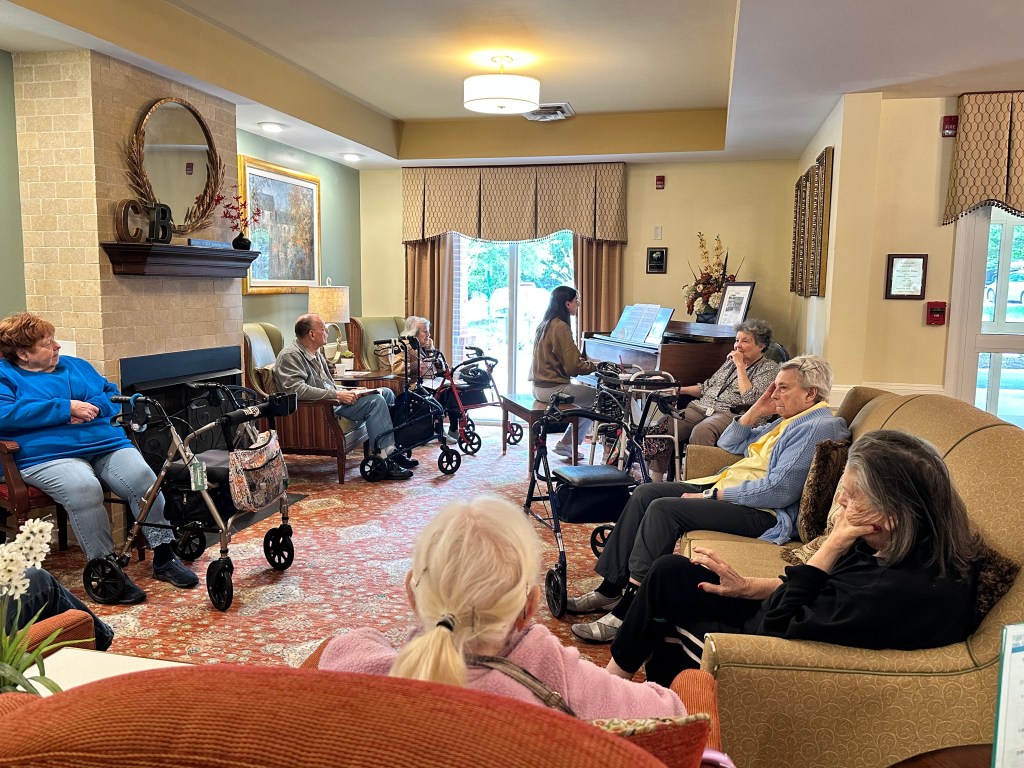
After setting up an Easter party at a local senior residence, I was about to head home, but out of the corner of my eye, I saw a woman sitting quietly in the lobby. An aura of elegance and sophistication surrounded her, inexplicably drawing me toward her.
“Hello, how has your day been?” I asked, bursting her bubble of peaceful solitude. Lines of wisdom etched into her face, her piercing blue eyes sparkled in the sunlight, and her silver hair swayed gently in the afternoon breeze drifting through an open window nearby.
“How was my day?” she quipped, staring back at me. “Not eventful.” Her words, thick with a Slavic accent, dripped with skepticism and disinterest written across her face.
There was no overt dismissal in her response, but no encouragement either, leaving the conversation in an uncomfortable limbo. To mask the awkwardness, I rambled on about Easter and asked if she had any plans for the day. Again, her wizened eyes seemed to bore into me.
Well, this wasn’t going as I had planned. Attempting to break the ice, I explained that I volunteered at the senior living center during school breaks, helping organize holiday events and occasionally playing piano for the residents. At the mention of the word “piano,” her eyes lit up, a sparkle brightening her countenance.
“I used to be a piano teacher,” she said as a smile flickered across her face. Then, gesturing toward the piano I was leaning against, she asked if I could play something.
Caught off guard and with no prepared repertoire, I faltered. I hadn’t practiced for months between preparing for the AP Calculus exam and leading my school’s Biology Club. “I didn’t bring my music,” I murmured, embarrassed. “I haven’t had much time to play lately. High school can be overwhelming.” To soften the disappointment, I added, “But I used to perform at state competitions.” She nodded, her eyes softening.
“The last piece I learned was Chopin’s Winter Wind etude,” I blurted, in an attempt to validate my credentials as a classically trained pianist.
Out of sympathy or perhaps amusement, she smiled, and her icy façade began to melt. “I’m Inna, by the way,” she introduced herself. “Nice to meet you.”
As we conversed, I learned that she had been a classical pianist trained at the prestigious Tchaikovsky National Music Academy in Kyiv. After the dissolution of the Soviet Union, she emigrated to the US, leaving her family behind to pursue a better life. “I miss them terribly,” she admitted, her voice tinged with poignant sorrow. “It wasn’t until I left that I truly realized how important my family was to me.” Her memories slowly sprang to life, erupting through the cracks of her carefully guarded demeanor. Increasingly, I became captivated by the rich experiences of this reserved woman. Inna spoke about both the positive and negative aspects of her native and adoptive countries. Her reflection on her decision to leave Ukraine deeply resonated with me as a child of first-generation immigrants. I had grown up witnessing my mother’s longing for the family she left behind in China two decades ago to chase her dreams here.
“Always fight for your dreams,” she said wistfully. Her unfiltered advice, shared with vulnerability, touched me profoundly, making me feel as if we had known each other for years. “But remember to accept the things you cannot change, have the courage to change what you can, and the wisdom to know the difference.” Though she didn’t elaborate on her dreams, I sensed they were intertwined with her love for music. “I used to practice piano from dawn to dusk,” she reminisced, her voice brimming with nostalgia.
As our conversation continued, I shared my school life, my musical journey, and how the loss of my grandparents shaped my desire to serve the elderly in the senior living. Soon, I realized how much I relished the connection with a grandmother figure, and how rewarding it felt to take the risk to initiate this conversation. Before we parted, I made a promise to play for her on my next visit. “What about Beethoven’s Pathetique Sonata, the third movement?” I suggested.
“That is my favorite!” she exclaimed, nodding enthusiastically.
What began as an attempt to strike a casual conversation with an interesting woman turned into a genuine desire to connect with her, and reignition of my music passion. Every day, I carved out time from my busy schedule to master Pathetique. While practicing my music, I found an exhilaration not just for the beautiful melody, but also for the chance to perform it for a very special person.
A month later, at a luncheon honoring high school volunteers, I unexpectedly spotted Inna sitting with a group of residents knitting by the piano. I walked over, adjusted the piano bench, took a deep breath, and began to play the melancholy opening chords in C minor of Pathetique – a tale of anguish and denial mirroring Beethoven’s struggle against his growing deafness. As my fingers danced over the keys, the theme transitioned from a pugnacious fight to pensive reflection, culminating in the acceptance of life’s inevitability. Through the music, I felt as though I were telling Inna’s story – her pursuit of dreams, her resilience, her losses, and her eventual peace. My fingers flew across the keys building tension in the recapitulation before fading into a serene, cascading descent.
Looking up, I met Inna’s eyes shimmering with pride. A connection of kindred spirit surged through me, despite the decades that separated us. In the burst of applause, I couldn’t hear her words, but I didn’t need to. Her radiant smile and approving nod said it all.
 Telos and Tangents
Leave a comment